Racial Diversity When Race Doesn’t Matter

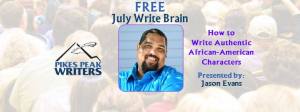
PPW Write Brain African American CharactersTonight I am attending an event sponsored by Pikes Peak Writers on writing authentic African-American Characters. This Write-Brain is very timely for me, because lately I’ve been wondering a lot about how to make sure my stories don’t come across as white-washed. However, at the same time, I want to write a character whose physical characteristics such as skin tone don’t really matter.

Tonight’s presentation focuses on African-American characters. Presumably people with dark skin who live in the United States currently or sometime in the last couple of centuries. For most of my stories, I’m interested in writing characters who live in a fictional future world.

I’m looking forward to learning a lot, and I’ll share what I garnered from tonight’s event in another blog post later. Meanwhile, here is a SFQotD post from earlier this month, discussion the topic of race in fiction. This question had some very insightful responses.

SciFi Question of the Day from July 7, 2016:

When writing about an off-Earth human-colonized society, are the goals of 1) writing racially diverse characters and 2) writing so that race/nationality/skin color truly doesn’t matter… mutually exclusive? Can a SciFi writer do both when an image of the character may never appear on a book cover, illustration, or screen adaptation? #SFQotD

From the Public Post on Google Plus:

 Michelle Cameron

 Personally, I’d not even mention these characteristics. Our world is changing so rapidly, that any of these might easily geolocate the story as written in your nation/time. I probably wouldn’t even adopt gender-based pronouns.
.

 Annette Holland

 You could reframe it as “racially diverse = characters from the human race that exemplify all of our diversity” vs “alien race that sees us as bothersome two-legged oxygen breathers”.
.

 Ilyanna Kreske

 I believe that if you want a racially diverse cast you need to be explicit because otherwise the reader’s implicit bias will likely whitewash the characters.
.

 Masha du Toit

+AmyBeth Inverness I think it depends on what you mean by “writing so that race… Etc… doesn’t matter”?

There’s a difference between believing that such things don’t necessarily define what kind of person a character is, and recognising that humans do, in fact, tend to be prejudiced or experience prejudice.

I think it all depends on what you are doing with the story. I could believe a story that doesn’t reflect our own racial and class divisions, but it would be more difficult to believe in a world where no divisions and prejudice exists.

.


 Annette Holland

Why assume that all readers of sci-fi are white? Implicit/unconscious bias, yes, but if characters are vaguely described then anyone of any ethnic make-up will ascribe characteristics that look like the people around them.
.

 Lisa “LJ” Cohen

This is something I considered when I started to plot out the first Halcyone Space book. I knew I didn’t want to fall into the trap of creating white/male as default for my characters. And I couldn’t imagine a space-faring future that was LESS diverse than the current society in which I live.

So I deliberately created characters from a variety of cultural and racial backgrounds. BUT, I didn’t recreate the social stratification that society currently has that is so focused on race.

Instead, I played with status in different ways, using professions (the mixed-race sons of the space station’s physicians are considered higher status than the white daughter of the engineer) and geography (there are still haves and have nots on Earth, but it’s less related to race – Dev struggles with her place at University because she was raised in a post-flood settlement and is looked down on because of it.)

I also extrapolated forward from my own experience in terms of how much my characters might hold onto from their cultural heritages. My grandparents were immigrants from Eastern Europe. They all spoke multiple languages and kept to their religious and cultural practices even as they learned English and settled into this country. My parents were born in the US and always considered themselves Americans. They could understand Yiddish, but didn’t speak it. Nor did they understand or speak any of the other languages their parents spoke. I neither understand nor speak any of my forebearer’s languages. My cultural identity is American.

It seemed logical that this generational shift would continue to take place as we humans move into space.

I can well imagine, however, a different scenario where specific cultural groups might use the opportunity of a space colony to create an enclave – kind of like what Quebec is in greater Canada. But given how interdependent colonies would be – especially in the beginnings of a diaspora – I would imagine that such isolated communities would not fare as well as more diverse and connected ones.

.


So to give a more succinct answer to your question: No. Not mutually exclusive. And there is no doubt looking at the cover for book 2, that Barre is not white. 🙂
.

Ilyanna Kreske

 +Annette Holland – I didn’t assume all readers are white. Unfortunately, studies have shown that unless explicitly stated otherwise, even POC readers tend to mentally imagine characters as white. This is one of the many reasons it’s so important to write diverse stories.

And if you don’t believe me, consider the fuss when Rue (hunger games) was cast as Black even though that’s how she was written. See also: staging Harry Potter with a Black Hermione.

.


 Arlene Medder

 This is something I’m working on right now. I have a story off an accidental human colony (they were colonists, mostly, but not for this planet and not all headed for the same colony).

Part of what I do is pull from a wide range of languages for the names. I include references to appearance, ‘he kept his dark brown eyes on the dials’, ‘the light reflected dimly from her olive skin’, but I’m still working on describing people without resorting to the tired food and wood cliches. And without going medical (I’m still working on how to indicate eyes with an epicanthic fold without using the word ‘almond.)

.


 Nathan V

Perhaps not mutually exclusive, but certainly tricky to handle. The majority of readers are likely to default to the predominant race of their homeland.

One thing you mentioned in another post was Hermione being black. The problem with that issue– not that I’m notabsolutely okay with a WoC portraying the character– isn’t just that the readers defaulted to Caucasian, but that JK did, too. Hermione wasn’t described in racial terms, but at the same time:

“Thomas, Dean,” a Black boy even taller than Ron, joined Harry at the Gryffindor table.

They all swiveled around in their seats and saw Angelina Johnson coming into the Hall, grinning in an embarrassed sort of way. A tall black girl who played Chaser on the Gryffindor Quidditch team, Angelina came over to them …

“And this is Kingsley Shacklebolt” — he indicated the tall black wizard, who bowed …

.

 Annette Holland

+Ilyanna Kreske I’m a PoC reader and if only physical descriptors are given (non-blond stick straight hair, eye color that isn’t blue, button nose, etc.) without regards to race, I assume a person of mixed ancestry, such as myself and my family members, or, you know, Brazil. We’re all going to be brown one of these days.

I prefer writers who just write people. Racial identity in books brings along so much negative connotation, and if you are writing a future where mankind has expanded off Earth, why the heck are you bringing along all that hatred and bigotry. Humans are going to have to band together as one to deal with the aliens. Or what? Have ethnically segregated planets?

.

 Arlene Medder

+Annette Holland
Thank you!
 .


 Mince Walsh

Like any conflict, bigotry requires two sides, one that is prejudiced, one that is not. Unless there is a conflict (even when referring to the past bigotry, or the bigotry of a distant colony) it does not seem possible to emphasize diversity unless you at least refer to the stupidities of the past.
Prejudice is conflict. While there appear to be some people who seek to isolate people by appearance or lifestyle, there is always someone who uses that to divide and conquer us, without which that prejudice would likely die out as that instigation is brought to light and snuffed. IMO the only way I can see this actually happening though, is if scientists could find a solution that suppresses negative emotions in the affected groups until they could acknowledge just how stupid prejudice is.
.


 Annette Holland

You don’t have to emphasize diversity if you write a story that just is. Write people that interact with each other as people. It’s called character development. Conflict can come from defects in character. Defects in character are not related to ethnic make-up. One race. Human. Ethnogically diverse.
.
 

 Annette Holland

Clarification +AmyBeth Inverness is this a human only world or will you be introducing non-humans?
.

No aliens
They can be fun to write, and allow a POV character to look at the humans from a fresh perspective, but once you introduce an alien race the story tends to gravitate towards alien/human interaction and conflict.
I love Star Trek TOS but they used “Spock can save us! Vulcans have the ability to ____!”
 .


 Annette Holland

+AmyBeth Inverness Bujold is one of the best at writing diverse characters without making them all seem CIS/white nor being heavy handed on “this is a black person, this is an American Indian, this is an Asian”. Nathan Lowell does it fairly well too.
*

From the Google Plus Science Fiction Community

 Gustavo Campanelli

All paths of life had a place in our little corner of the universe. And I didn’t think that mattered until I found out a conept called segregation in an ol book in our library. I never mentioned it to anybody, I didn’t want to expand this poison in our happy unity.
.
 

 Big Fat Hairy Marmot

Since race doesn’t scientifically exist here on earth you could only include race if you were talking about off earth societies. Given enough time for genetics to drift in isolation, different planets/colonies,they might have time for sufficient change as to form “races” or “sub-species”
.
 

 Jeff Sauri

Just because a book doesn’t have an illustration doesn’t mean the author won’t provide a description. When the reader can visualize the character, it helps to connect the reader emotionally.

Additionally, it depends where the author wants to introduce conflict. Is the colony united against a struggle with an outside force? Then it probably doesn’t matter if the colony is diverse or homogeneous. If there is conflict between different factions in the colony, then race could be a valid basis, or they could use something else like status, profession, birthplace, whatever.

Ultimately, if the author develops a strong character based on something other than racial stereotypes, then the character should be interchangeable. For example, changing the gender of Starbuck in the Battlestar Galactica reboot, or changing the race of Nick Fury in the Avengers movies.

Relying on the reader’s assumptions of race as a substitute for actual character development is just lazy writing.


 Jonathan Kelley (ViolatedGorilla)

When I write for the most part I don’t really think about the characters’ appearance. I tend to be focusing more on what is happening.

.

 Charles Mills

 I gotta be honest, if you are trying to do one, then by definition you aren’t doing the other.
.

 Michael Newman

Actually I would say all the problems of a society start over again from square one.. First you would have Prejudice and segregation and hopefully it would evolve into some kind of civil rights reformation and Renaissance period….. the first colonists are there with more people than anything else and without the luxury of resources from the Homeworld.. They are trying to terraform and start a colony.
.
 

Michael Newman

 It isn’t some kind of space station.. If one religion or one ethnicity was more prevalent than the others, then you would begin to see problems.
.

 JC Smith Hamner

It depends upon the premise of the story. If you go with ‘*2*’, you had better have developed a legitimate reason for the social evolution, and as such, should be a major part of the message of the story, otherwise it fails one of the pillars of science fiction by simply parroting an extant liberal ideal instead of exploring it.

The goal should not be diversity in and of itself, but if there is or is not diversity in the colonies, it should be something that is integral to the plot and its ethical implications.

Asimov, I think, handled this fairly well inNemesis by having the colonie*s* realistically be varied in their contrasting makeups, some being homogeneous (culturally and ethnically), some being more diverse. Homogeneity has its inherent internal functional efficiencies, and it’s important to understand these and their consequences within the larger context of societal growth and the consequences of majority rule and exclusion, and colloquial attitudes and apathy resulting from insularity.

*


From the Speculative Fiction Writers Group on Google Plus

 Gert Sønderby

People get described all the time in books. Not eliding such traits as skin color, bone structure, epicanthic folds or hair texture will allow you to put all manner of people in your work. As well, wherever we go, we take our cultures with us. Often, living together, we then mix them (c.f. a Scottish fast food joint that sells Pakistani authentic curry – with battered, deep fried haggis. Yes, it’s real.), but there will be recognizable things in there. And yes, make sure to mention the skin color of any white people too, they’re not the default.

A case study: Naomi Nagata is a major character in the book series The Expanse by S. A. Corey. She is described as light-brown skinned, with almond shaped eyes, curly hair. She’s a Belter – grown up off Earth in low gravity – and thus has a large head and a slender, elongated body. Descriptions have featured mention of how her last name must imply Asian ancestry, but that the only outward sign was slight epicanthic folds in her eyes.

Other characters have various attachments to Earth cultures – one is quite clearly and explicitly Indian, another character is from Mars but descended of Indian parentage, and he speaks with a Texas-style drawl affected by his home region.

.


 Sally Sue Ember

 In the West, no mention of ethnicity means presumably white.
.

 Louis Doggett

Hmm, I think David Weber does that with his Honor Harrington series. By the various names, with skin color mentioned rarely but as part of the description or story, color doesn’t matter but you can tell its there.
.

 Gert Sønderby

+Louis Doggett And occasionally he’s very explicit about it, driving home the point that yes, Queen Elizabeth of Manticore is, in point of fact, black. Or he has a scene (or was that Eric Flint’s? They collaborated on that one) where a professor explains American black slavery to an audience two thousand years later, using said queen and her highly decorated naval officer (and just as black) cousin as examples of people who would have been enslaved.
.
 

 Louis Doggett

+Gert Sønderby Yes, he can be explicit about it but at the same time it doesn’t really matter to the other characters.
.

From Facebook’s Public Post:

Jay Dias Jay Dias  Maybe have a look back through the Foundation series. It comes up in, I think, Prelude to Foundation and otherwise Asimov pretty intentionally avoids these kinds of descriptors.

In the movement, though, not seeing race is problematic. Race is a socialrather than a biological concept but it does matter – it matters because it matters. In other words, if we do not see race, then we blame the individual for their immediate circumstances rather than acknowledging decades-centuries of systematic oppression. That’s not an approach I would carry forward into a series of books.

It has become passe to talk of the American “melting pot” as that’s Borg-ish. We don’t want to eliminate biological distinctiveness. The more modern goal is not assimilation at all but learning to value diversity. What do people bring from their various backgrounds and experiences that makes us stronger and more admirable?

.

Bob 'Hawk' TurnbullBob ‘Hawk’ Turnbull  Humans are still basicall humans, think one would tend to try creating a new mix of what we were and what we’ve become due to the evolution of living in a different enviroment. Maybe even how they would react when exposed to old Earth enviroment (as visiting an Earth station or ship)
.
Jay Dias Jay Dias  This might be a little deeper than you want to go but…

I see the danger of un-raced humans as coming from the biases of the writer. Ethnocentrism. The trouble is, they wouldn’t be un-raced, they would likely be white (unspecified). We write what we know; when we’re white, we write white people and assume once the “differences” are stripped away we would be the base-model human.

Not doing this would be really difficult. It would really require having a large number of experiences outside the usual field of our daily interactions and a lot of thought. In what way would each contributing culture add to the culture one is creating? In what ways will this be unlike a standard Euro-American society? what new values and behaviors will emerge that come from none of the contributing societies? What about bottlenecks – traits carried forward due to the small size of the initial founding population?

.


Fatma Alici Fatma Alici  I may hit you up with some follow up questions about this. My SciFi background for my books has some unusual aspects. I worry about the actual real life validity of some of the ideas.

I feel to actually and heart sick to get into them now.

.

AmyBeth Fredricksen AmyBeth Fredricksen  A couple of the Google Plus threads blew up on this one.
.
Jay Dias Jay Dias  Did they? Flaming and so on or honest dialogue?
.
AmyBeth Fredricksen AmyBeth Fredricksen  Almost completely honest dialog. Although a few days ago, the question on cultural appropriation… that turned nasty and I had to delete comments.
Jay Dias Jay Dias  hm.
.
Don Branum Don Branum  How far in the future is this set? Because skin color has mattered for at least the last 500 years or so. What makes it no longer matter between now and the time in your setting?
.
AmyBeth Fredricksen AmyBeth Fredricksen  The story I have in mind is only 100 years in the future, and close enough to Earth to get new arrivals every day.

But it’s interesting to ponder the generality… such as:

How long must a society be completely removed from Earth before it’s almost impossible to tell what part of Earth a citizen’s ancestors came from? (Because the gene pool just kept mixing…)?

.


Don Branum Don Branum Probably on the order of generations to centuries, depending on the level of isolation and hardship. The smaller the group, though, and the more people are forced to work together, the faster those cultural prejudices will disappear.

Of course, that may give way to new prejudices, e.g., how Earthers are all rich, spoiled, and lazy.

.


Jay Dias Jay Dias There’s this: people tend to sit closer to people most like themselves, when given a choice (“take this chair in that room and have a seat”). People with similarities tend to aggregate/congregate. Watch classrooms seat roughly by gender and ethnicity, beardiness, specatcledness and so on.

Such prejudiced are likely to proliferate into the future because that’s what we do: find people like us and favor them.

.


Bob 'Hawk' Turnbull Bob ‘Hawk’ Turnbull  A century could produce ‘created evolution’ (adapting to some chararistic of the envoriment, like adjusting to low gravity) however would not be enough for natural evolutionary change. Look at the length of time it took from Neanderthal to Cro-magnon to modern man…
.2016 July Smashwords Promo
Posted in SciFi Q of the Day | Tagged , , , , , , , , , | Leave a comment

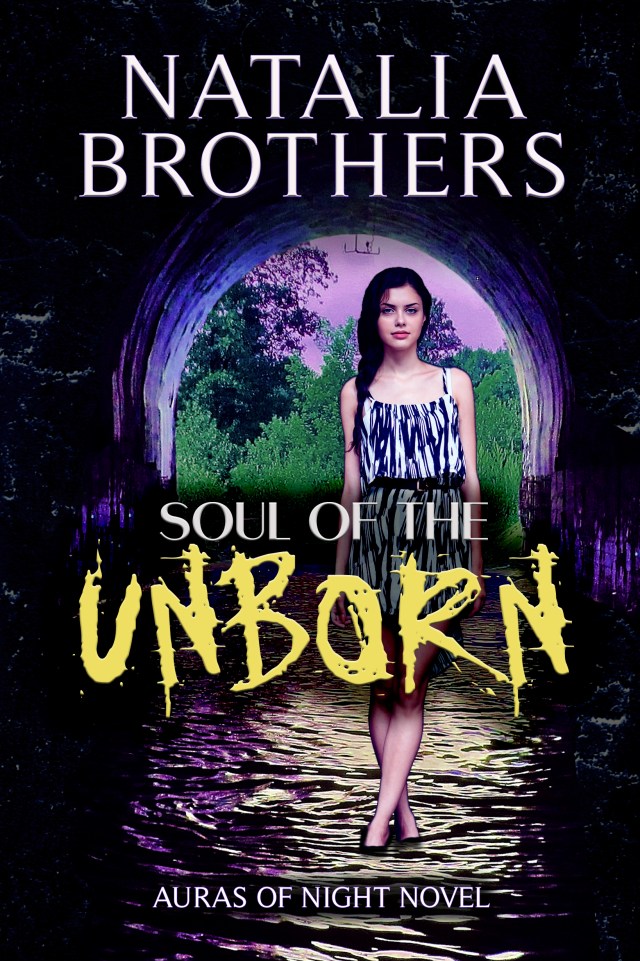
Interview with Natalia Brothers

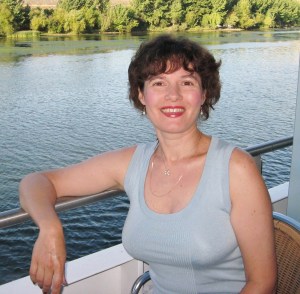
Profile Photo Natalia BrothresBorn in Moscow, Natalia grew up with the romance and magic of Russian fairy tales. She never imagined that one day she’d be swept off her feet by an American Marine. An engineer-physicist-chemist, Natalia realized that the powder metallurgy might not be her true calling when on a moonless summer night she was spooked by cries of a loon in a fog-wrapped meadow. What if, a writer’s unrelenting muse, took hold of her. Two of her passions define her being. Natalia is an orchid expert and she writes dark fantasy.

  1. What brought you from Moscow to the US? What made you decide to settle in Colorado Springs?

I fell in love with and married an American Marine. Virginia was a beautiful place to live, but after eleven years I still couldn’t adjust to the summer heat. One day we saw The Broadmoor hotel on the Travel channel. The lake, the mountains—the breathtaking scenery prompted us to take a trip to Colorado Springs. A few months later, we called Colorado home.

1 AmyBeth Interview

  1. I visited Moscow in 1989, as a senior in high school with the Boulder-Dushanbe Sister Cities program. I’ve never been able to go back. Is it very different now than it was then?

Yes and no. I’m a suburb dweller now, and whenever I visit my family and friends, Moscow never fails to impress me with its lights, bustling streets and metro stations, new buildings, and gorgeous parks. But when I go to my summer place, the tall willows still grace the river banks, nightingales’ singing lasts until predawn, and the faraway sound of late trains stirs in me bitter-sweet surges of nostalgia. I welcome the changes. I love the comforting familiarity.

2 AmyBeth Interview

  1. Did you grow up with dark tales in your family mythology, or did you not hear the stories until you were older? What made you decide to write about them?

My grandmother, an excellent storyteller, took my childhood friends and me on scenic hikes along the river and told us tales of clairvoyance, séances, and witchcraft. I doubt she realized how her stories affected our susceptible young minds. It seemed the past was filled with magic—scary, astounding magic—something we’d never experience in our “modern” lives.

But what would happen if we did? How would we react when forced to face an actual paranormal manifestation?

Who would you tell about it?

Who would believe you?

No, no one in my family was stillborn and resurrected by a supernatural entity. SOUL OF THE UNBORN is a fantasy. A dark fantasy.

3 AmyBeth Interview

  1. How long did it take you to write Soul of the Unborn? How many revisions did the story go through?

English is my third language, and when I started the first draft, Autocorrect couldn’t figure out which words I was trying to spell.

“Why didn’t you write it in Russian?” asked Laurie Wagner Buyer, an award-winning literary author I met at a workshop.

“Not enough challenge,” I said.

Laurie liked the answer. She became my literary mentor.

I attended workshops and conferences. I read books on writing and grammar, entered contests, and found great critique groups. The novel—a finalist and winner of many contests—was improving with every draft, but I was adamant about rewriting the manuscript from scratch until it fit my vision of the story.

I read my seventh version and knew I had reached my goal.

  1. What was your path to publication?

I participated in a Twitter pitch contest, received eleven “favs” from nine publishers, did my research—and spent two stressful months waiting for the verdict from the publisher I wanted: City Owl Press. I signed the contract the day it was offered. Working with the team has been a fantastic experience.

  1. Will the story be translated into Russian?

Я была бы очень рада. I would like that very much.

  1. What is next in your writing career? Would you consider writing about aliens? Perhaps some dark SciFi?

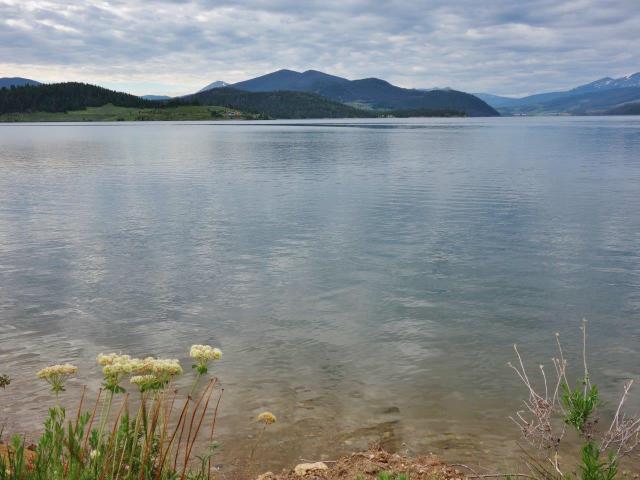
Anything is possible. It’s places I visit that inspire my writing. This picture was taken two weeks ago on a beautiful lake in Colorado. My next trip is going to be to Loch Ness! (No, really, it’s already booked.)

4 AmyBeth Interview

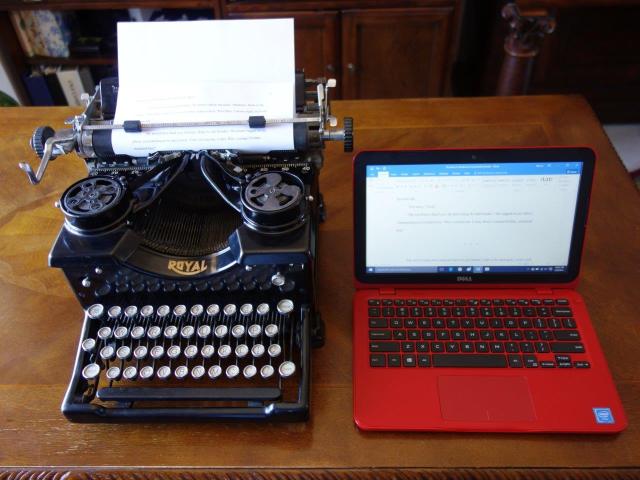
  1. What is your favorite electronic writing tool? What is your favorite non-electronic writing tool?

Here they are:

5 AmyBeth Interview

  1. What would your ideal writing environment look like?

Typing and editing—anywhere, but brainstorming requires “me” time. Nothing like a long hike to solve an intricate plot quandary.

6 AmyBeth Interview

  1. As an orchid expert, what do you do? Have you ever trekked through the jungle in search of rare species?

To simplify my job description: I know the answer to the “Why my orchid doesn’t bloom?” question! From de-flasking (removing seedlings from flasks) to bringing orchids to bloom and creating arrangements—I’ve enjoyed every step of the process.

7 AmyBeth Interview

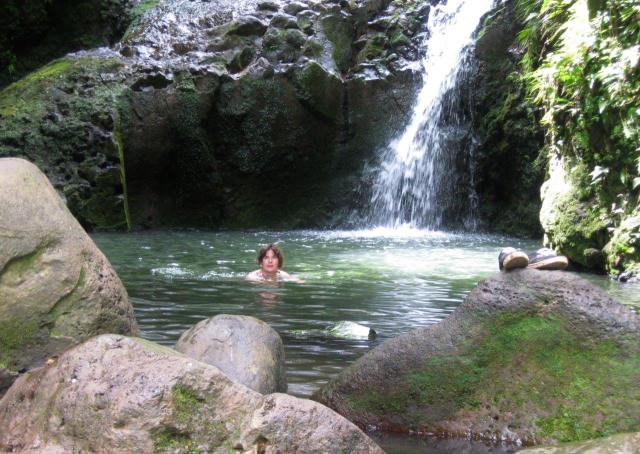
As for trekking through the jungle…I had a dream—to swim under a tropical waterfall. Off we went, to find one in a Hawaiian forest. It was a trek alright, and a very bad idea because I cannot stand the heat. (We finally reached the waterfall, and the water was unexpectedly cold. So cold, I barely managed to take a dip in the pool for a “been-there-done-that” picture.)

8 AmyBeth Interview

Since that walk, I never stray far from air-conditioned civilization. Jungles can keep their secrets.

Russian meadows are a different matter. I remembered an exquisitely scented plant from my childhood that we called Forest Violet. I suspected it was actually an orchid. It took a while, but I was thrilled to find it again and confirm my guess.

9 AmyBeth Interview

  1. What Colorado authors (besides me) do you think more people should discover?

Joel Q Aaron, Kari Wainwright, Donnell Ann Bell, Debbie Maxwell Allen, Holly DeHerrera. And Pam McCutcheon, author of “Writing the Fiction Synopsis.”

  1. Who shot first? Han or Greedo?

I’d guess it’s whichever version you saw first. But because AmyBeth mentioned aliens, I keep thinking, What would Ellen Ripley do?

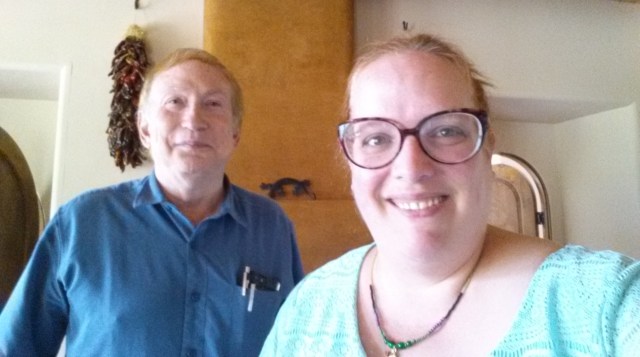
Natalia and AmyBeth at Kawa Coffee in Colorado Springs

Who, amongst your friends, family, and acquaintances, is most likely to be an alien or metahuman in disguise?


I love it when I get to meet an interviewee in person!2016 July Smashwords Promo

Soul of the Unborn

Coming this November from City Owl Press

Unborn DIGITAL1 copyCan you call yourself human in your every breath, every desire, every emotion is generated by supernatural forces?

Posing as a folklore-tour guide, Valya Svetlova takes a group of American college students and their professor, Chris Waller, to her summer home in the Russian village of Vishenky for a few nights of supernatural phenomena. She works hard to appear a perfect hostess. Valya doesn’t want anyone to discover she harbors selfish motives when it comes to one participant, the only person who can refute a wicked tale declaring her a stillborn resurrected by a paranormal entity, a puppet in someone’s horror show destined to perish in the otherworldly dimension.

Within hours of their arrival, Valya learns that the students, too, foster some dangerous agendas. Her nascent feelings toward the handsome professor inhibit her ability to control the supernatural manifestations and her inquisitive guests. When her unforeseen affection turns Chris into a target of the malevolent forces, Valya faces the excruciating reality. It’s no longer in her human power to ensure her guests’ safety. But to keep Chris and the students alive, Valya must brush off her humanity and become something she fights so desperately to prove she is not. A soulless monster.

Posted in Interviews | Tagged , , , , , , , , , , , , , , | Leave a comment

My Pitch to Publishers 2016

Thank you for taking the time to visit my blog! Last year’s #Pit2Pub was a great success for The Cities of Luna and I’m hoping to do even better with Kingdom Come.

I am querying a SciFi-Rom duology set on the human-colonized world of Kingdom Come. The Jubilation of the Southern Cross is complete at 72,000 words and Hearthsong is complete at 85,000 words. Together, the duology is titled From Earth to Kingdom Come. Both manuscripts are available, in part or full, upon request. This duology is the beginning of a planned series.

THE JUBILATION OF THE SOUTHERN CROSS: BOOK ONE OF FROM EARTH TO KINGDOM COME

Bethany intends to spend her four-month star voyage lounging by the pool and going over the mounds of data her new employers send her every time The Jubilation of the Southern Cross drops out of FTL. She ignores the constant flirtation from Richard, a traveloguer who is returning home to the same city where her new office will be. Richard is nice, and it is helpful that he knows many of the people she’ll be working with, but he makes a game out of flirting with not only her, but anything with two legs.

A casual flirtation with Drew, a concierge who works for the starline, begins to snowball into something more. With Richard’s advice, Bethany uses Kingdom Come’s traditional parting ceremony to end the relationship. But Drew is in love with her, and refuses to let her go. Although he could be fired for having an affair with a passenger, they continue their relationship in secret, aided by Richard.

Richard soon becomes entwined in their relationship. Although being with two men at the same time seems scandalous to Bethany, it is considered a rather small group to Richard, who grew up in the polyamorous society of Kingdom Come. To complicate matters, Bethany is pregnant, which only solidifies Drew’s insistence that he will never let her go.

Toward the end of the voyage, when Richard proposes marriage, Bethany spontaneously agrees even though her brain is telling her she’s being rash. When Richard insists the ceremony take place while they’re still on board The Jubilation of the Southern Cross, both Bethany and Drew are surprised, but agree since it seems so important to Richard.

As the three of them draw close to Kingdom Come, all are wondering whether they’ve already found their happily-ever-after, or whether they’ve just stepped into an adventure greater than any of them has ever imagined.

HEARTHSONG: BOOK TWO OF FROM EARTH TO KINGDOM COME

Richard has spent fifteen years travelling from star to star and writing about exotic locales and unique vacation destinations. He has earned both his reputation and his fortune. When he learns that one of his fathers has died in a stupid accident, he decides to go home, even though no one there needs him or will be impressed by anything he’s accomplished.

Since starliners only visit his homeworld a few times a year, it takes him months to get home. On board The Jubilation of the Southern Cross, Richard falls in love with Bethany and Drew, and in a whirlwind romance the three of them get married before they reach Kingdom Come.

When Richard arrives with his new husband, new wife, and a baby on the way, his newlywed status earns him a reprieve from his large, overly-attentive, match-making family. But being married and staying on just one planet is difficult for Richard. He continues to travel, spending days or weeks elsewhere on the planet, continuing to write. He makes it clear that he hates being reined in, and soon Bethany and Drew stop asking his when he’s coming home.

Although the freedom is what he wanted, it doesn’t make him happy. He’s an outsider in his own marriage, a third wheel that could easily be disposed of at any time. To complicate matters, his wife not only works with but has become close friends with Sylvie, the woman whom all his friends and family expected he would come home to sweep off her feet. Richard holds Sylvie in high esteem, but he has no romantic intentions toward her. It irks him that so many people still seem to think the two of them are destined to be together, and he can see that it bothers her too, although she pretends not to notice.

The baby arrives, and Richard struggles to figure out where his place is in the marriage. The three of them have started to see other people together, in particular a marriage of five with whom they would add up to an ideal marriage of eight. Richard left Kingdom Come so he could be in control of his own life, and after fifteen years of doing just that, he can’t just surrender and let his new wife and husband make all the decisions about their family. Then again, that might be exactly what he needs to do in order to be truly happy.

This duology is the beginning of a planned series.

I have written several novels in this world. During the process of writing, I created a warm and vibrant civilization that approaches marriage and child-rearing as a team. Writing polyamorous romance, however, can be quite complicated. To simplify, most stories focus primarily on one or two characters. The stories are grouped together in mini-sets such as From Earth to Kingdom Come, which is a duology. The first book focuses primarily on Bethany, and the second book focuses primarily on Richard. The first book ends in a ‘small’ marriage of three, and the second book ends in that marriage expanding to include several more spouses. The next set, Dogs, Cats, and Allergies, focuses on certain dog-loving characters in the first book, cat-loving characters in the second, and the third book brings them all together.

My hope is to contract with a publisher who is eager to explore the non-traditional strategy of releasing sets of two to five books as a set. Each set includes an overall story arc that would be lost if only the first book was released. Whether they are all released at the same time, or once a month, or some other schedule can be discussed with consideration to marketing and other factors.

More details about the series as a whole can be found on my Kingdom Come page on this blog.

I will be checking in with #Pit2Pub throughout the day, then organizing queries and such this evening. I look forward to making lots of new contacts!

Posted in Kingdom Come, Writing | Tagged , , , | Leave a comment

The Turning Point

The Squirrels are Back in the Attic

The Squirrels are Back in the Attic

I wish I had a crystal ball. I wish we could see what the future holds, and plan accordingly.

It has been a weird summer, after moving to Colorado Springs in March. Monday hubby started a new job, and it also happens to be Bible School week at church. I’m playing chauffeur all day every day. I reluctantly gave myself permission to drift through the first three days of the week in a sleep-deprived fog.

The weird thing about this is that I’m actually getting more writing in, though not the big blocks of time I prefer. I have a story in a notebook…one of those 10″ by 7″ (ish) ones that are a dime a dozen at back-to-school time and $2-$10 each the rest of the year. They’re perfect for The Cities of Luna because they easily hold just over five thousand words when I write on only one side of the paper. If my word count gets super high (like it did with Pastor P) then when I get to the end I turn it upside down and start writing on the back sides of the pages.

I prefer to type. I can go much faster that way. But having the notebook means I can write anywhere, like poolside at our apartment complex while the kids swim, or sitting in the parlor at church while the girls are in Vacation Bible School. My writing turns out disjointed when I write in short bursts like that, but at least the story gets out. Everything gets fixed in edits.

My writing goal of five days a week is close, but not quite. I think it was four, and some of those were only a few hundred words.

My goal of promo six days a week wasn’t quite there either. It should be easy to just share one link to something, anything related to my writing, each day, but I keep slacking. I don’t want to be spammy.

The goal related to Camp NaNoWriMo is the most difficult. I have not yet touched the story. It is still only one-third done, which it has been for many moons now. I’m not yet ready to throw in the towel, though… I only need about twenty thousand words, and that’s doable in a couple of weeks. It’s like regular NaNoWriMo.

Although I gave myself permission to let things slide while my schedule is whacked, there are a few important things I need to do on Wednesday:

  • First is linking up with A Round of Words in 80 Days and visiting at least a few friends’ blogs. I’ll be a little slackish and not bother to add all the usual links into this post.
  • I have a book club meeting at the local library tomorrow. I really enjoyed Maloka’i by Alan Brennert; that’s what we’re discussing tomorrow.
  • I wrote a story for a contest and I’m quite pleased with how it turned out. A friend is looking over it now and I’ll do a last round of edits before turning it in. It’s due Friday.
  • Wednesday is also Pitch2Pub on twitter. I only remembered late this afternoon. Fortunately, the novel I’m pitching is the same as last year, so I just need to tweak the tweets I used then. I’m tired tonight, but after I finish this blog post I will write another one specific to From Earth to Kingdom Come, the duology I’m pitching tomorrow. I will be taking a risk, and instead of insisting that my story fits all the normal parameters publishers look for, I will confess the out-of-the-ordinary hopes I have for the series.

Hopefully this week is a turning point. Hopefully, after this, I can settle into a somewhat more normal routine and get on with all my ambitious plans.

Or at least make my ROW80 goals.

2016 July Smashwords Promo

Posted in NaNoWriMo, ROW80, Writing | Tagged , , , , | 5 Comments

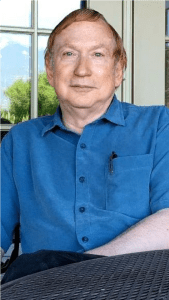
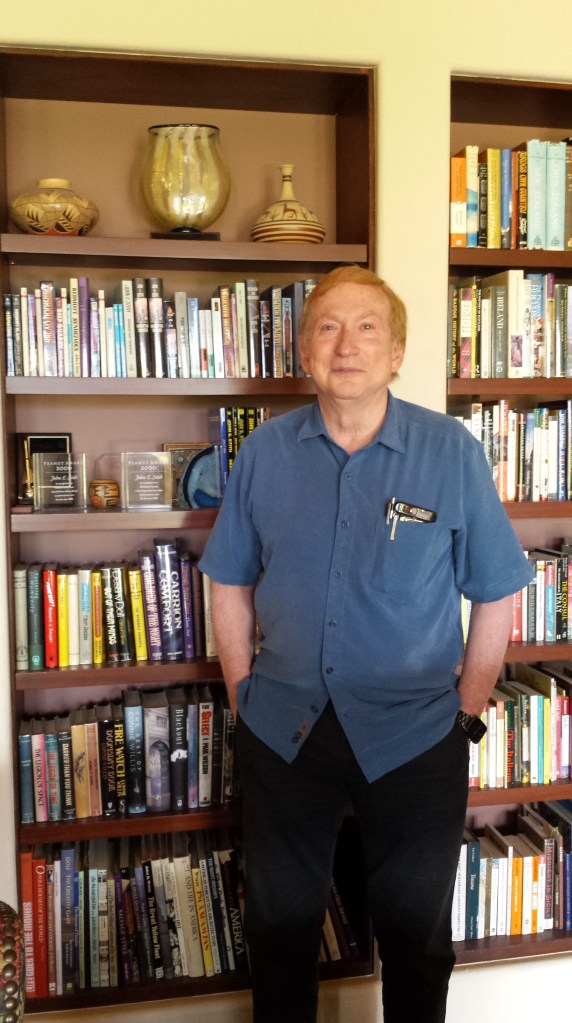
Interview with John E. Stith

Stith Profile PicScience fiction and mystery author John E. Stith writes across many worlds. His books have been translated to French, German, Italian, Japanese, Portuguese and Russian and are even available in braille for the sight-impaired. His stories have been categorized as “Hard science fiction,” a label given to those stories thoroughly researched to play fair with the rules of science; something any die-hard SciFi fan can appreciate.

It was during the summer Science-Math Institute for High School Students at Cloud State College, John served as editor for the school paper, but several more years would pass before the urge to write, strengthened by years of loving to read, was too compelling to ignore. His stories vary, but his books are packed with suspense, mystery, and humor.

Stith holds a B.A. in physics from the University of Minnesota, has served as an Air Force Officer, where he worked at NORAD Cheyenne Mountain Complex. The passion for science runs in his family, as his father George worked at the White Sands Missile Range on such projects like the rocket sled.

He has appeared on a live nationwide PBS broadcast or Science-Fiction Science-Fact (SF2) and his work has also been sold to film and television. His novel Reckoning Infinity was chosen as one of Science Fiction Chronicle’s Best Science Fiction Novels, Redshift Rendezvous was picked as a Nebula Award nominee and Manhattan Transfer received an honorable mention from the Hugo Awards and a nomination from the Seiun Award in Japan.

Stith is a member of Science-Fiction and Fantasy Writers of America (SFWA), Mystery Writers of America (MWA), Writers Guild of America (WGA), International Thriller Writers, Rocky Mountain Fiction Writers (RMFW), Colorado Author’s League and Mensa. He currently lives in Colorado Springs.


  1. Stith cover collageI am pretty sure I saw your name on my father’s bookshelf back in the eighties, but that was when I was a teenager and I picked up any SciFi I could get my hands on and barely paid any attention to the author, publisher, or even the title. Unfortunately, most of that library disappeared when they retired and flew south. Are these old titles still available?

All of my novels are still available in used bookstores, and they are all being re-released by ReAnimus Press at approximately 45-day intervals, starting with DEEP QUARRY on July 1, 2016. Next will be MANHATTAN TRANSFER on August 1, and then REUNION ON NEVEREND on October 1.

  1. How has the process of writing and publishing changed over the course of your career?

For one thing, the publishing world has consolidated into fewer primary markets. A number of smaller presses have sprung up. But probably the biggest change is that Amazon opened up the market for self-publishing. That can be a godsend for niche books, quality books that just don’t have a broad audience, good books that don’t appeal to the typical gatekeepers, and new works for people who have an audience but want more control. Unfortunately it also opened the gates to a minority of writers who see the audience as willing beta readers and aren’t patient enough to learn the craft before they start publishing, so they taint the market for the writers who have learned the craft, making it that much harder to be seen. There are many fine independent books; they’re just harder to find than they could be.

  1. Which of your stories required the most research?

REDSHIFT RENDEZVOUS took the very most. I had a surface familiarity with relativity, and even now I’m far from an expert, but for that book I created a hyperspace craft running in a region of hyperspace where the speed of light is ten meters per second, so relativistic tricks happen at observable speeds. Run, and the view ahead shifts to blue, and you can create sonic booms. There was so much work, I included an appendix to discuss it.

But most things I do wind up necessitating research. MEMORY BLANK needed background and information on Gerard O’Neill-style L-5 orbital colonies. MANHATTAN TRANSFER required another trip to Manhattan and research into things as varied as aqueduct and subway tunnel locations and landmarks in Manhattan.

  1. Which of your many covers is your favorite?

I can’t narrow it down to just one. Among the covers commissioned by Ace Books and Tor Books, I especially liked Richard Hescox’s cover for DEEP QUARRY, Alan M. Clark’s cover for REDSHIFT RENDEZVOUS, and Darrell Sweet’s cover for MANHATTAN TRANSFER. For the ReAnimus Press releases, I most like Takumer Homma’s cover for DEEP QUARRY, Sina Pakzad Kasra’s cover for REUNION ON NEVEREND, Julian Faylona’s cover for REDSHIFT RENDEZVOUS, and the RECKONING INFINITY cover done by a combination of Jorge Abalo Budczinski’s creation with Mandelbulb and the 3D figures done by my art director, Kavin King.

  1. If you could have lunch with Robert Heinlein, what would you talk about?

Hero worship regarding several of his novels (THE DOOR INTO SUMMER, RED PLANET, and others) and “What were you thinking?” about a few more.

  1. Can we look forward to seeing any of your stories on screen?

I hope so. I’ve written a number of feature screenplays and periodically pitch them to people in a position to proceed.  Currently a producer wants to do a low-budget pilot for MANHATTAN TRANSFER.

  1. Of all the awards you’ve won, do you have a favorite, or one you’re most proud of?

Being a finalist for the Nebula Award, an award voted on by my peers, felt wonderful. It’s tough competition every year, but that year I acutely aware of ferocious completion from Dan Simmons and Ursula K. Le Guin and Jane Yolen.

  1. John Stith Bookshelf 02What is your favorite electronic writing tool? What is your favorite non-electronic writing tool?

OneNote has taken over my top spot in the electronic arena. It’s just so convenient for keeping track of research and characters and ideas. It’s like having a searchable file cabinet that you can organize however you like. I don’t think I have a favorite non-electronic writing-specific tool, unless you count my brain.

  1. What is your ideal writing environment? Have you ever been able to create it?

One that’s relatively quiet, and near the right temperature. I love a dual-screen environment so I can keep an outline and character notes and the current manuscript page in view all the time. I face away from the view to minimize distractions. I run PhoneTray to ward off telemarketers and robocallers. If I were king the penalties for autodialer abuse would be stiff enough to make it totally stop.

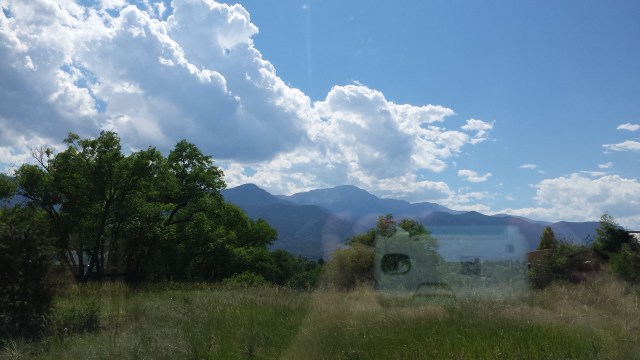
  1. View of Pikes Peak from John's dining room.

    View of Pikes Peak from John’s dining room.

    What are you working on next?

Several things. I have a psychological suspense novel that needs another major draft. I’ve got a time-travel novella that I’m trying to decide whether to expand to novel length. And for the producer who wants to do a pilot for MANHATTAN TRANSFER, I’m working on the script and bible for that.

11. When you worked at NORAD, were they tracking Santa? Was there a Stargate functioning at that time? Is there a secret passage from NORAD to the giraffe enclosure at Cheyenne Mountain Zoo?

I knew about Santa thing, but kinda felt it could be a scam. The Stargate was above my pay grade. I don’t think I saw anything about the zoo tunnel even in AVIATION WEEK, the place where you could normally spot articles for the public that revealed stuff we were unable to mention because it was classified.

  1. What Colorado writers (besides me) do you think more readers should discover?

That list is so long and includes so many friends that I’m afraid of forgetting someone, but alphabetically, and limiting this to SF & fantasy, I’d include Kevin J Anderson, Doug Beason, Paolo Bacigalupi, Carol Berg, Edward Bryant Jr., David Dvorkin, Cynthia Felice, Wil McCarthy, Rebecca Moesta, Dan Simmons, Steve Tem, Carrie Vaughn, Connie Willis, David Zindell. A list three times this long would still omit some good writers here.

  1. Who shot first, Han or Greedo?

Man this discussion has grown so contentious, especially in the last decade, that I really hate to wade in. I think in general, people on the right say that even if Han had shot first, he was clearly just protecting himself from an eminent menace, while people on the left aren’t sure a guy as cocky as Han should have been allowed a lethal weapon in the first place. The libertarians pretty much don’t care. But after running the Zapruder film back and forth for twelve parsecs, I’d have to say that with light-based weapons it depends on your frame of reference.

2016 July Smashwords Promo


John Stith selfie 02


Posted in Interviews | Tagged , , , , , , , , , , , , , , , , , , , , , , , | Leave a comment

The Third Round’s a Charm

Photobombed by an Alien

Photobombed by an Alien

Round Three Has Begun!
We’re off to a …well…we’re off.

I’ve been accomplishing a lot. The writing hasn’t been there as much as I need it to be, but it’s there. One night I stayed up until 5AM to finish a story. I brought a notebook to the fireworks show so I could write during the 5 hours leading up to the finale. However, even though it is now July 6, I have not added any words to my Camp NaNoWriMo project.

My goals for this round:

1.Write at least five days a week.

  • Less than 1,000 words, but more than zero is not-so-great, but acceptable.
  • Between 1,000 and 2,000 words is all right.
  • More than 2,000 words is good.

2. Promo something six days a week.

3. Finish The Beekeeper’s Mother by the end of July


I will be leaning heavily into getting my wordcount in, even when there is a ton of other work to do. All that other work is worth nothing if I don’t actually write. It’s good to have a story going in a notebook even if the main WIP is on the computer. If I add 100 words to the notebook, it still counts as a writing day.

I have two medium-term-goals that go just beyond this round.

First, I want to finish my urban fantasy novella  The Beekeeper’s Mother by the end of July, and have all the editing etc. done by the end of the summer so I can release it in October. It’s the second book in Lillie Lane, my urban fantasy series. Every novella is made up of three short stories. Each novella stands alone, with brand new characters. I’d like to put these out once a year.

2017 is the 50th anniversary of the beginning of the Apollo missions, beginning with the tragedy of Apollo 1 in January. I plan to put together a collection of The Cities of Luna and release it in November, both in electronic and paperback form. There’s a lot of work that still needs to be done…

Who’s doing Camp NaNoWriMo?

New project? Or finishing up an old one?


Posted in NaNoWriMo, ROW80, Writing | Tagged , , | 9 Comments

The Little Things

20160616_161542I have a very specific memory, probably around fourth grade, of our teacher handing out two assignments for us to do. One was very short, and the other would take longer. We were instructed to do the short one first and turn it in before starting the other.

Some intellectually conceited part of my brain said I knew better. I would do the longer one first and impress everybody! Alas, it did not work out that way. Everyone else turned in the short one, and the teacher came over to find out why I hadn’t. Instead of impressing everyone, I was embarrassed.

As an adult, I understand that it’s usually a good idea to get the little things out of the way before tackling the bigger items. However, as a writer and in ‘real life’, the little things can pile up to an overwhelming deluge of tasks. Some priorities are clear, others are not.

Today is the start of Camp NaNoWriMo. Normally, I would have watched the clock tick past midnight, and started writing as if someone had said “On your mark, get set, GO!” I didn’t do that last night. I was looking at a short story I wrote for a specific call to submissions that is due at the end of July. I also re-looked at the deadline (mid July) for a contest I’m planning to enter. I need to edit the first story and submit it. I need to finish writing the second story.

Other things on my to-do list are to write interview questions for the next on my list, and to look carefully at my notes and see whether, while rearranging, I ended up double-booking folks. I need to finish beta-reading for a friend (I’d promised to be done by the end of June. He knows I’m going to be late.) I need to dive into Camp NaNoWriMo. I need to format and prepare a dozen stories that are now down (under the publisher’s name) and put put them back up under my own name. Besides all that, there are a dozen little things that I could and should do, such as writing promo blog posts and designing memes and things to share.

On a side note—I know that not many people read these randomly musing posts—for the first time in my life, today I have food stamps. I am incredibly grateful that this option is available to my family in our time of need. Hopefully we will only need them for a couple of months. A year from now, I think I will look back at this post and say “Oh wow… look how far we’ve come!”

It would be very easy to just cruise around the nine tabs I currently have open on my computer (only three of those are social media) and procrastinate it all. I won’t let that happen. Although what my brain wants to do is dive into a brand new story that has nothing to do with NaNoWriMo, I will take care of the little things that involve other people first. I will take care of the tasks that are small enough to only take a small amount of time. I may not start my NaNoWriMo project (The Beekeeper’s Mother) until tomorrow, but I’m OK with that. July Camp is much more laid back than November’s full-blown novel-in-a-month.

Meanwhile, I will write a musing blog post that is definitely not on my to-do list, because it warms up my brain and gets me set for what’s next.

Oh look, I just did.

Multi cover banner 2016 06 28

Posted in Commentary & Musing | Tagged , , , , | 4 Comments

Interview with Ron Sparkman

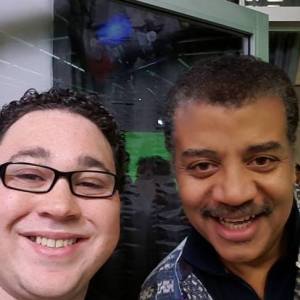
Sparkman and Neil DeGrasse Tyson

Sparkman and Neil DeGrasse Tyson

Ron Sparkman is a professional D.J. of 15 years who was inspired by the reboot of “Cosmos”, hosted by Neil deGrasse Tyson to become a science communicator. The show ignited a fire in Ron to make drastic changes in his life, transitioning from a life of all style and no substance, to one inspired by the scientific and cosmic world.

Ron is starting his 10 year journey to a PhD in astrophysics this fall and plans to tick off all the qualifications of being a NASA astronaut. His major goals include climbing the 7 summits of the world and being one of the 80,000 colonists Elon Musk plans to take to Mars.

His passion for space and science inspired him to create his website UpportunityU.com, where he shares science museum reviews, interviews with industry professionals, and much more. Check it out at UpportunityU.com and on social media at Facebook.com/UpportunityU and Twitter.com/UpportunityU.

1.      How would you characterize the first thirty-four years of your life?

Shew. That’s a hard one to pin down. Colorful. Expansive. Well-lived. I’ve been able to do so many things that most people never get to do and I feel honored in that way. But I’m only getting started.

Ron Sparkman tree

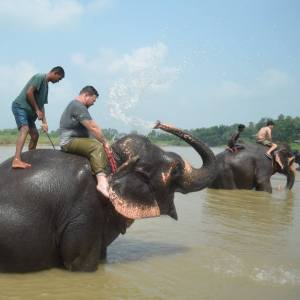
Chitwan National Park on the border of Nepal and India

2.      Have you always been a geek? Are you now?

Always been a geek for sure. Started young with the Transformers, G.I. Joe, and X-Men cartoons and just continued from there. Video games were a big thing for me; the perfect solace for my more tumultuous teen years. And I am still currently super geeky! I think it’s the best time to be one since “geek is chic” right now. The endless influx of new Comic and Sci-Fi movies is a beautiful thing. It’s a great time to be alive.

Ron Sparkman museum

Sparkman at Perot museum, Dallas

3.      What made you decide to make major changes in your life?

I don’t know that I really decided, but my impetus for change was the Neil deGrasse Tyson-helmed Cosmos reboot. After the 15 minutes, when he has explained at length the size of the observable universe and just how much was out there, I felt a shift in perception. The epiphany so many of hope for in life. It upended my entire life in a beautiful way. I’ve not stopped asking questions since.

Sparkman and Dr. Amy Mainzer of JPL's wise and neowise.

Sparkman and Dr. Amy Mainzer of JPL’s wise and neowise.

4.      What are your long-term goals?

To be an effective science communicator like Dr. Tyson, Dr. Amy Mainzer, et al. To get a PhD. in astrophysics and work with the James Webb Telescope and its successor. And to be astronaut qualified via the qualifications NASA shared last fall which are: a 4 year degree in a STEM field, plus either 3 years in said field (or a Master’s degree in your field) or 1000 hours jet-engine training. My plan is to have all of those qualifications in 10 years.

In the end, the ultimate goal is to go to space. (I don’t care if it’s a suborbital flight or part of the 80,000 person settlement Elon Musk looks to have on Mars, I just want to be out there in it.) I want to inspire people to realize that they can be whatever they want to be, whatever their age, whatever they *think* their mental capabilities are. We can all be more and I think that should be our bigger goal. To elevate humanity and see the stars. I just want to make the world a better place before I leave it.

Sparkman with Michio Kaku

Sparkman with Michio Kaku

5.      What have you done so far toward these goals?

It’s definitely been a concerted effort the last few years. I mostly gave up my old life DJing and left a 6-figure career to basically start over as a poor college student. I started fighting all my fears. At 33, I didn’t have a driver’s license, I was scared of flying and heights, I was a high school dropout because of intense bullying, and more. Now, at 35, I’ve driven all over the country, I conquered my fear of flying through science (I read books on the physics of it), I flew into the scariest airport in the world and then trekked through some of the Himalaya mountains, I got my GED and I’m slated to start college in September. I volunteer at the Space Foundation, I run my own space and science website at UpportunityU.com, and I work hard on being as involved in possible in educating kids of all ages on everything STEM. Next year, I begin flying lessons.

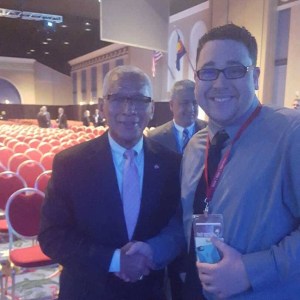
Sparkman and NASA director and former astronaut Dr. Charles Bolden

Sparkman and NASA director and former astronaut Dr. Charles Bolden

6.      How fit does one have to be to enter the astronaut program at NASA?

Very. If you get a chance to check out the website, NASA gives the qualifications for it. I led a pretty party heavy lifestyle through all of my 20’s and into my 30’s, so the biggest thing for me has been changing all of that. I rarely drink and have entirely changed my eating patterns. I’ve lost 40lbs this year by hitting the gym for short, intense workouts, eating 5-6 portioned meals a day consisting of complex carbs, lean proteins, and essential fats, and then I throw in a cheat meal or cheat day every week.

Everest

Everest

If you’ve ever read Body for LIFE, it’s very similar to that approach. To further push myself, I became a mountaineer. The training is so intense! I did the Everest Base Camp Trek last September and am currently planning on doing Aconcagua in January to celebrate my first semester of college. (I’m still in shock I’m ACTUALLY going back to college.)

Sparkman and Former astronaut, ISS commander, and CEO of OneOrbit, Dr. Leroy Chiao

Sparkman and Former astronaut, ISS commander, and CEO of OneOrbit, Dr. Leroy Chiao

7.      How do you plan to fulfill the educational requirement for NASA?

A PhD. in astrophysics is my main goal. I want to work for NASA before I fly with NASA. New projects like the James Webb Telescope will tell more about the universe than even being on the surface of the Red Planet. But I don’t see why someone can’t strive for both.

8.      What else will you need to accomplish in order to enter the astronaut program?

Quite a few things. My age will be a factor so I want to hit all of the aforementioned qualifications NASA asks for in its candidates. I will also continue to improve my physical and mental fitness. I want to lose another 70lbs, continue to increase my understanding of the world, and to research as much as possible on personal development. Better ways to control my emotions and make rational decisions. To be able to see beyond a scary moment and figure out the answer to complex questions. I will also need to become more mechanically inclined. Flying lessons will be my first real dive into the waters of engineering and I’m excited to step outside of my comfort zone and learn all about it. I have a friend who inspired me to beat my fear of flying, Billy Michelson. He grew up with a father famous for flying, cleaning the airstrip on his family’s property. He’s been instrumental in my beating my fear of flying and educating myself on just what it takes. Flight is truly one of the most beautiful achievements for humanity.

Sparkman with Bill Nye

Sparkman with Bill Nye

9.      Have you ever met Neil deGrasse Tyson?

Yes, I have! I joined the Patreon group for StarTalk, Neil’s spaceand science podcast. And part of being a top-tier pledger is the ability to meet with the stars of the show like Neil, Bill Nye, David Grinspoon, Janna Levin, et al. It was one of the most amazing days of my life. I was so nervous to talk to him, that I just wrote him a letter just in case. I gave it to him, but I’m not sure if he ever read it. But I will say this. People say you should never meet your heroes. In this case, that is absolutely untrue. He was so passionate and kind and willing to open everyone in the room’s horizons. He is everyone’s best friend. He’s noted for saying that Carl Sagan inspired the kind of person he wanted to be. In my eyes, he’s achieved that. One of my other goals is to be on StarTalk as a guest someday. Fingers crossed.

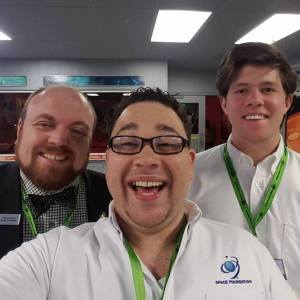
Sparkman with Travis Schenck (left) Director of Space Foundation's Discovery Center, and fellow volunteer Kyle Nachbar (right)

Sparkman with Travis Schenck (left) Director of Space Foundation’s Discovery Center, and fellow volunteer Kyle Nachbar (right)

10.  What volunteer work do you do at The Space Foundation? Where can visitors find you there?

Shew, I do it all! I absolutely love being there. Space Foundation has everything from NOAA’s Science on a Sphere presentations, a large carbon fiber globe that has stunning images of celestial bodies–and just about anything else science-y we want to share–projected onto its surface. This allows us to utilize it in an interactive classroom format and give our guests a Cosmos-live style show. I love it. We have a robotics lab that’s styled as a Mars lab. A 3-D exhibit from DLR on Mars. A continually expanding space gallery featuring artifacts from the world’s space agencies. A plethora of revolving exhibitions of all kinds like MathAlive and our current one, Super Kids Save The World. We even have a VR app called Cosmic Cruise that I was lucky enough to narrate with the Director of Space Foundation’s Discovery Center, Travis Schenck. Another one of my goals (I have quite a few) is to work there full-time someday. I love everything I get to do there and all of the people I get to work with. And there’s nothing better than seeing the smiling faces of kids who have the same crazy dream that I have…to go to space someday.

Ron Sparkman crater

Meteor Crater, Arizona

11.  What is the group Science in the Wild?

Science in the Wild is an idea created by the brilliant Dr. Ulyana Horodyskyj.  The group aspires to take people from all backgrounds and then get them involved in science in some of the most extreme environments in the world.

I was introduced to her through my friend who inspired me to do the EBC trek. “Dr. Skittles”, as she has been so lovingly nicknamed, wants to educate the indigenous peoples of these far-flung high-altitude paradises and she does that through her scientist-sherpa initiative. Everyone on the expedition gets to learn about the science of what her team is doing and be part of the projects she’s working on such as helping to combat climate change. I’ve also bugged Ulyana about joining her team when I’m a qualified astronomer. I’d love to drag telescopes up the world’s tallest mountains to experience high-altitude, crystal-clear, freezing cold skies, completely devoid of light pollution. Pretty much the most amazing conditions possible for a starnut.

Chitwan National Park on the border of Nepal and India

Chitwan National Park on the border of Nepal and India

The next major expedition is to Aconcagua in January 2017. Check out the website and feel free to join the crew! It’s going to be incredible.

12.  Should humanity go back to the moon? To Mars? Or both?

Both! I see humanity as a space-faring society someday, very similar to Roddenberry’s ideas. Elon Musk and Jeff Bezos are on track to make these sorts of huge visions for humanity a reality. At the very least, I want to be in the room when they happen. But obviously, I’d like to experience them first-hand.

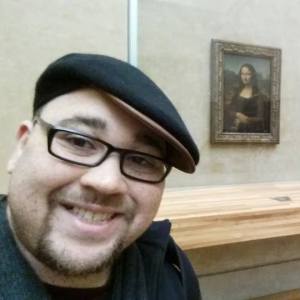
Mona Lisa, Louvre, Paris

Mona Lisa, Louvre, Paris

13.  Who shot first, Han or Greedo?

Han walked away with the win on this one, no matter who shot first. 🙂

.

Ron and AB at the Space Foundation in Colorado Springs

Ron and AB at the Space Foundation in Colorado Springs

.

.Multi cover banner 2016 06 28

Posted in Guest Blog Posts, Interviews | Tagged , , , , , , , , , , , , , , , , , , | 1 Comment

Ready or Not, It’s a Wrap

ROW80LogocopyMy Wednesday writing updates are coordinated with A Round of Words in 80 Days, the writing challenge that knows you have a life. Eighty days is just under three months; we have four rounds a year.

Round two just came to a close.

Round three will begin in July.

This is a wonderfully supportive group that encourages me and helps me to set goals for my writing career. It’s very easy to let things slide or push certain tasks to the backburner if you don’t set specific goals. ROW80 has been instrumental in keeping me honest with myself about just what I’m accomplishing.

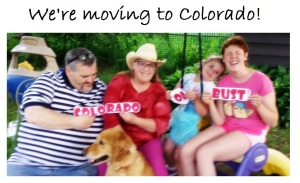
The big change that will come with Round Three is that I allowed myself to fall back on the writing in order to juggle everything that was involved with our move from Vermont to Colorado. CO or bust AnnouncementThat move actually happened in February, in the middle of Round One, but it wasn’t that simple. Round Three is the end of the fallback.

I’ll spare you the details, but if you’re curious about the move you can read about the saga on my family blog.

Part of me is screaming “But…everything isn’t settled yet!” It’s true. Hubby’s still job hunting, there are services for my daughter’s special needs that are not yet in place, and I need to attend an orientation for UCCS where I’ll be finishing my bachelor’s degree in history this fall. (I have two associates’ degrees…I wished they added up to a bachelor’s, but alas, nope.) We’ve enrolled our younger daughter in a charter school (they are common here) and I want to make sure she is consistently getting everything she needs. Real life commitments are piled high.

Putting my writing career on the backburner was a temporary thing. It wasn’t shelved; I kept writing, just not nearly as much. The Cities of Luna continued to come out with every full moon. Letting things go for three months, Round One, was understandable. Letting things go for six months, through Round Two, was an unexpected necessity. I won’t let things go for three more months.

I did a twitter pitch event today for Kingdom Come, but I didn’t find out about it until it was underway and I jumped in late. I didn’t get any bites. There’s another twitter pitch event (Pit2Pub) coming up in July, and I’ll do that one to.

July is Camp NaNoWriMo, which is a mini version of November’s event. I’m going to finish The Beekeeper’s Mother, an urban fantasy novella in three parts. I’m woefully unprepared… I need to finish beta reading for a friend, I have two short stories that I wanted to submit to specific markets in July, and I need to continue my regular schedule with The Cities of Luna . I haven’t re-read the part of the the story I’ve already finished. I haven’t looked at my notes about what comes next. The only meals I’ve made ahead and put in the freezer are a few meatloaves.

But it’s time. Next Wednesday my update post will include goals for Round Three, which will be much more substantial than Rounds One and Two. Ready or not, it’s time to wrap up all the loose ends and dive in with renewed strength and positivity.

I can do this!

Will a little encouragement from my friends.

.Multi cover banner 2016 06 28

.

Posted in NaNoWriMo, ROW80, Writing | Leave a comment

Interview with Jamie Ferguson

About Jamie…

Jamie FergusonI’ve wanted to be a writer for as long as I can remember. We moved around a lot when I was little, so I can easily pin down my age based on where we lived, which means I was maybe six when I first made this proclamation. My writing has changed quite a bit over the years, although I am still proud of the short story I wrote in 8th grade about an orangutan named Inconspicuous (I was quite taken with that word).

My writing focuses on characters. I’ve created stories about ghosts, clones, monsters, escape artists, mermaids, circus performers…I’m all over the map. But in every single story I do my utmost to get into the minds and hearts of my characters. I love to put them in awful situations to see how they feel, and how they think. I want them to agonize over their choices, and I want what they choose – or don’t choose – to matter. I want the reader to feel joy when a character succeeds, and to cry when they don’t – just like I do when I’m writing the story.

Writing is far more fun and rewarding than any other job I’ve ever had, and I’ve been fortunate to have some good day jobs. None of them have ever had the appeal for me that writing does.

My ‘free’ time is spent in a futile quest to wear out my two herding dogs since I haven’t given in and gotten them their own herd of sheep.

  1. How did the Fantasy in the City bundle come about?

I met Chuck Heintzelman, the founder of BundleRabbit, at a writing workshop in Oregon in February. One of the authors at the workshop, Leah Cutter, was curating the first bundle on BundleRabbit, and it sounded like a really neat idea. After watching the progress of Leah’s bundle, I decided to put one together myself. Most bundles are of book-length works, and since I only have the one novel out so far I thought: why not put together a bundle of short stories?


  1. Fantasy in the City BundleWhat story do you have in the bundle?

“The City Trees.”  This is a brand new story that I wrote for the bundle. It’s set in the same world as the series I’m working on – the first book is The Language of Water, and if all goes well I’ll finish that manuscript this fall and publish it in early 2017.

These stories are set in our contemporary world, with one twist – beings like naiads, dryads, witches, etc. are real, but ‘normal’ humans don’t know they are real. Imagine you’re a naiad living in our present-day world. Sure, you’d spend time hanging out in your pond or creek or whatever, but you might also like going out to the movies, or eating pizza.

In “The City Trees,” the protagonist is a dryad who moved to the big city, but the city trees won’t speak to her. She finds herself caught in the middle of the theft of something magical and powerful.

The story was awfully fun to write, and it helped me figure out a few things that I was going to need to address for the series, which was an extra bonus!


  1. What is BundleRabbit?

BundleRabbit is an eBook-bundling website. It’s similar to StoryBundle and Humble Bundle.

The bundle curator (organizer) invites authors to participate, puts together the graphics, sales copy, etc. A bundle is more like a boxed set than an anthology. Each author packages his/her own story, so the look & feel of each one is exactly how that author wants it to be.  Bundles are on sale for a limited time (this one is available through July 10th), and readers can choose to donate 10% of whatever they pay to charity.


  1. Some writers love short stories, and some hate them. How do you feel?

That depends on whether I’m reading them or writing them. J

I generally prefer reading novel-length stories because if I like the world I want to stay in it for longer. That said, sometimes a short story is perfect just as it is.  One of my favorites is “The Rule of Names,” by Ursula K. Le Guin. It’s short and fun and wonderful.

I love writing short stories, but mine have a tendency to turn into novels. I have a long list of novels I’d like to write someday, and most of them began as short stories. My novel With Perfect Clarity, my soon-to-be-released novel Entangled by Midsummer, and the novel I’m planning on finishing in the fall all began as short stories. As an optimist, I try to look at this as a good thing. And since I’m also pragmatic, these days I usually put together at least a rough outline before starting a new short story.  That usually helps…


  1. In all your moving around, did you happen to be in Boulder in the eighties? I was in Longmont…we may have crossed paths and never known it!

Perhaps we did! I lived in Boulder from 1985-87, and returned in 1996.


  1. What was your path to publication?

I sold a few flash pieces in 2003, then wrote sporadically for years. In 2010 I wrote absolutely nothing for the entire year. I seriously considered giving up writing entirely, then for some reason started to pay attention to the publishing world. That was around the time when self-publishing seemed to be heating up, and I thought: why not publish my first novel myself? I already had a full draft of the novel. So I signed up for a few writing workshops in Oregon, hired an editor and a cover designer, and slowly put everything together.


  1. What are your long-term goals?

I have one main goal: to write full-time. It’s encouraging to see other writers make a living from their writing – to get there will take a long time, but that’s what I’m shooting for.

Specific goals are more transitory. For example, I have an in progress contemporary fantasy series, a bunch of notes on a western series I can’t wait to work on, and another fantasy series is in the very early planning stages. So that’s what I want to focus on in the short-term, but I’m sure I’ll add many more to the list before I’m done!


  1. What Colorado authors (besides me, of course!) do you think more people should discover?

Oh wow. Where to start?  There are many, but I’ll name just a few.

I spent many years in a writing group with the very talented Richard E. Friesen. He’s begun publishing his epic fantasy series The Dreaming King Saga, which I’m very much looking forward to reading.

Grayson Towler is in my current critique group. The Dragon Waking, his first novel, will be out in August. This is a middle grade fantasy that includes both dragons and dinosaurs. Grayson’s non-middle grade fiction is just as spectacular.

And of course DeAnna Knippling, who you interviewed in 2013. J I met DeAnna at a writing workshop in Oregon a few years ago, and still think about one of the stories she wrote for that class. Her short story “Bad House Spirit” is in the Fantasy in the City bundle.


  1. What is your favorite electronic writing tool? What is your favorite non-electronic writing tool?

My computer is my favorite electronic writing tool, of course!  As far as software, I’m not sure I could pick one package. I use Word, Excel (I love spreadsheets!), OmniOutliner, Scapple, and my new favorite, TiddlyWiki.  I’m using TiddlyWiki to organize all the information I gather when I do research, so that’s definitely an important one. It’s really annoying to google something for a story and realize you read the same article while researching another story six months before.

My favorite non-electronic writing tools would have to be white pads of paper and pencils. When I’m trying to work out a plot point, or come up with a rough outline for a story, I will jot down words and draw circles and things that don’t mean anything to anyone else (and often don’t mean anything to me either a year later).


  1. Jamie DogsWhat would your ideal writing environment be like?

My house, but with a few renovations. J I can write when there’s noise, I prefer writing at home where it’s quiet and I have access to everything I might need – research books, snacks, and of course my dogs.


  1. Would you recommend (to those who have the chance) taking a selkie as a lover?

Don’t get too attached! J  Selkie lore implies that they’re very amorous, but that they don’t often fall in love.


  1. EntangledbyMidsummer-200x300When will Entangled by Midsummer be out?

As soon as possible!

Curating the story bundle took way more time than I expected it to, so I’m a little behind where I’d hoped to be. Right now it’s looking like it will probably come out in September.


  1. Who shot first? Han or Greedo?

Han, of course!

…and a little Urban Fantasy from Lillie Lane…HPC Cover Promo Banner


Posted in Interviews | Tagged , , , , , , , , , , , , , , , , , | 3 Comments